
Hagia Sophia is one of the world’s most famous historic buildings, situated in Istanbul, Turkey. For nearly fifteen centuries, this building has been a symbol of civilisation, spirituality and culture spanning various eras. As well as being renowned for its architectural splendour, Hagia Sophia also holds significant importance in the history of Islamic waqf, demonstrating how the waqf mechanism has ensured the sustainability of a public asset over the centuries.
Originally, Hagia Sophia was built in 537 AD by the Byzantine Emperor Justinian I as the main church of the Byzantine Empire. Following the conquest of Constantinople by Sultan Mehmed II in 1453, the building was converted into a mosque. In the process, Sultan Mehmed II designated Hagia Sophia as a waqf (endowment) through a waqf deed (waqfiyyah). This designation was intended to ensure that the building, along with all its associated assets, would be maintained and utilised for the purposes of worship and the public good on a sustainable basis.
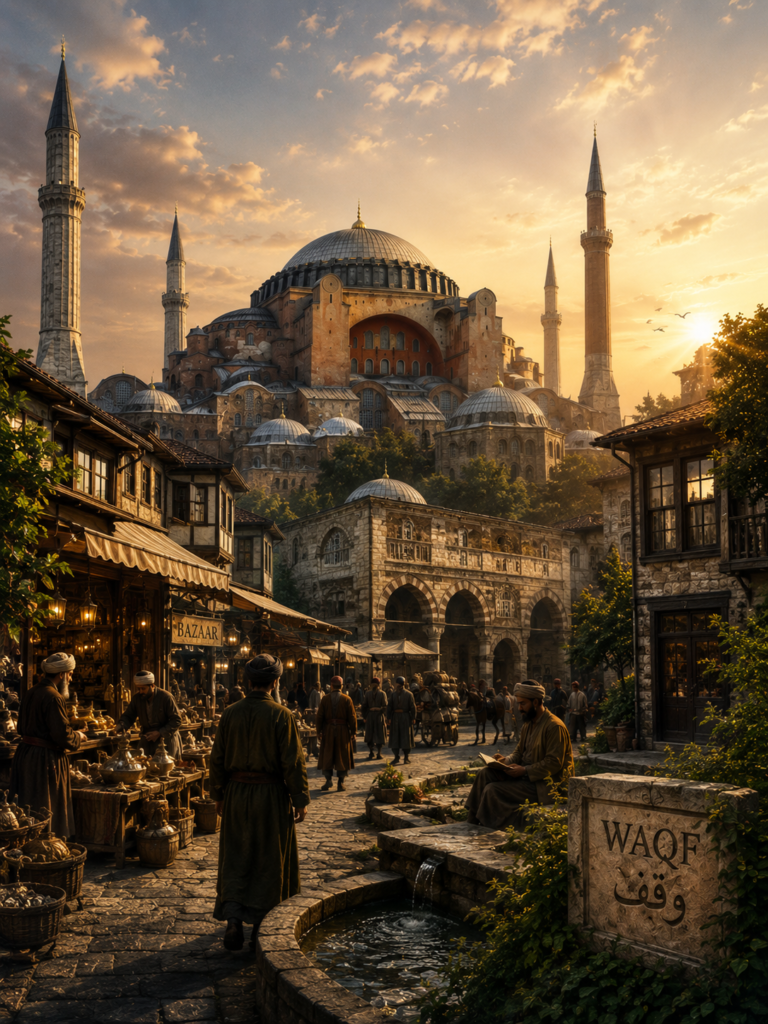
The waqf system applied to Hagia Sophia encompassed not only the mosque building itself, but also various productive assets such as shops, houses, markets, caravanserais and other properties. The income from these assets was used to fund the mosque’s operations, the maintenance of the building, the salaries of the imam and cleaning staff, the provision of lighting, and various other social services. This model demonstrates that waqf serves not only as a form of religious charity but also as an economic instrument capable of supporting the sustainability of public services without relying on government funding.
The successful management of the Hagia Sophia waqf stands as a concrete example of how waqf assets can endure for hundreds of years when supported by sound governance. The waqf deed drawn up during the Ottoman Empire sets out in detail the intended use of the assets, their management, and the prohibition on altering the waqf’s function. These provisions provide legal certainty whilst ensuring that the benefits of the waqf continue to be felt by the community across generations.
Throughout modern history, the status of Hagia Sophia has changed several times, from a mosque to a museum in 1935, and then back to a mosque in 2020. These changes have sparked various discussions from historical, legal and public policy perspectives. One aspect of particular concern is the existence of its waqf status, which was established during the reign of Sultan Mehmed II and remains a key consideration in Turkish law.
For the Islamic world, Hagia Sophia offers a valuable lesson that waqf is a development instrument with long-term impact. Waqf is not only concerned with the construction of mosques, but also creates a sustainable financing system through productive assets, the proceeds of which are utilised for social, educational and religious purposes. It is this concept that remains highly relevant for the development of productive waqf in various countries, including Indonesia.
As such, Hagia Sophia is not merely a historical monument, but also tangible evidence of the success of the waqf system in safeguarding the community’s assets over the centuries. This experience serves as an inspiration, demonstrating that professional, transparent and productive management of waqf assets can provide ongoing benefits to communities across generations.
refrence:
Zahir Aslan, 2025, XVI. Yüzyıl Arapça Bir Ayasofya Vakfiyesi, Jurnal: Tahkîk, Vol.15 2025.